
If you’re an accredited investor, there’s a good chance you have retirement money sitting in index funds or a money market account, earning modest returns and following the stock market wherever it goes. Many investors assume those are their only options inside an IRA or 401(k). They’re not. Your retirement capital is more flexible than most brokerage platforms make it feel.
A self-directed IRA allows you to invest retirement funds in real estate. The process is simpler than most investors expect, and the tax benefits can be significant, especially inside a Roth.
Here we take a closer look at why more accredited investors are moving retirement capital into real estate, how the process works step by step, and what to look for in an investment that fits inside a retirement account. Not every type of real estate works well here. The structure matters as much as the asset class.
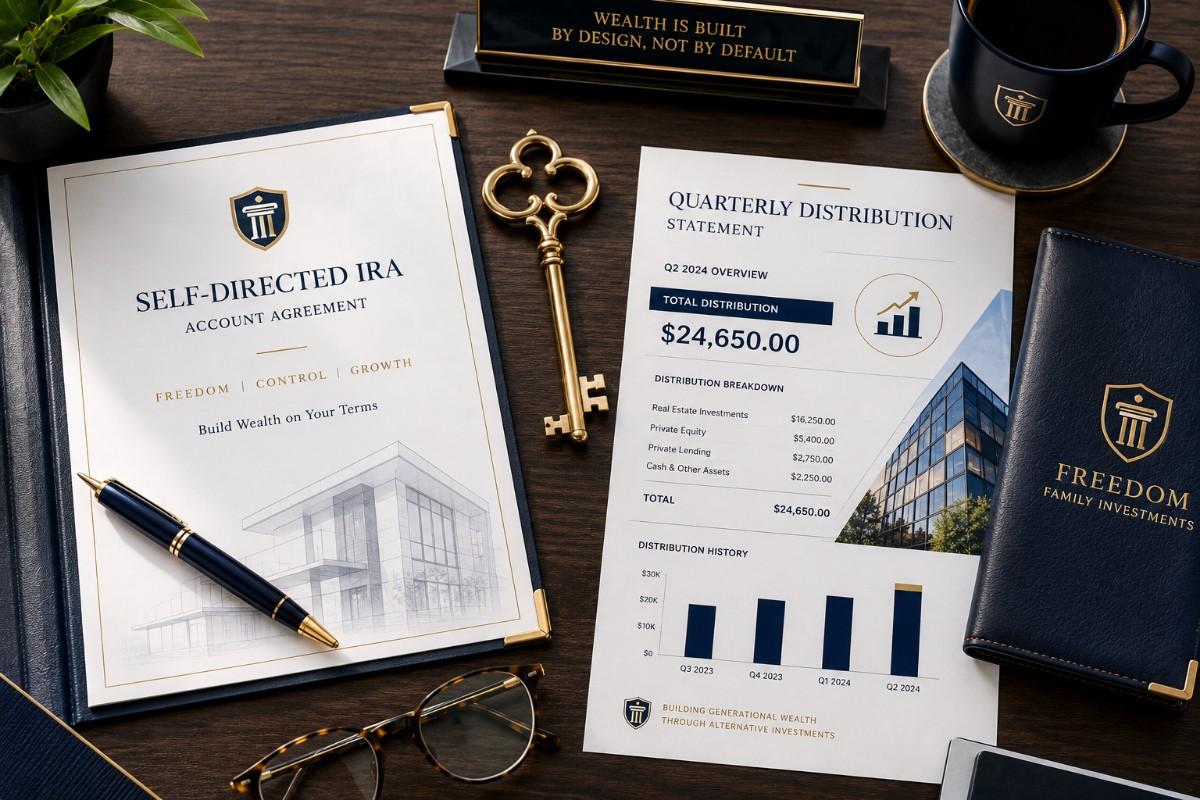
Why accredited investors are using retirement funds for real estate
If you have a retirement portfolio concentrated in equities, real estate isn’t meant to be a replacement for that. It’s a way to add a different kind of investment to the mix, one that can provide more predictable income. Here’s the case for carving out a portion of your portfolio for it.
The compounding math is hard to ignore. Most investors think of their IRA as a place where they take whatever the market gives them: 7% or 8% in a good year, and down 20% when things get rough. With fixed-rate real estate, you get a set rate before you invest and it stays consistent year over year. When you compound that growth for 10 or 15 years inside a retirement account, that consistency adds up.
Here’s a simple hypothetical. Two investors each put $100,000 into their IRA for 15 years:
| Scenario | Annual return | Value after 15 years |
| Market portfolio (with typical ups and downs) | ~7% average | ~$276,000 |
| Fixed-rate real estate investment | 9% fixed | ~$364,000 |
This is a hypothetical illustration, not a projection of any specific investment or a recommendation to replace public-market exposure. Actual returns will vary and are not guaranteed. Fixed-rate investments carry their own risks, including potential loss of principal.
The Roth angle changes the math entirely. If you have a Roth IRA and invest in a fixed-income real estate fund, your returns can grow completely tax-free. For investors who meet the qualified distribution requirements, that’s not a deferral. That growth is never taxed. That changes the effective return significantly, and for investors with a long enough time horizon, it’s one of the most powerful structures available.
Real estate isn’t dictated by the stock market. Real estate isn’t designed to swing with the stock market day to day, though the underlying investment still carries real estate and market risk. Adding an asset class that isn’t directly tied to stock market performance can give your portfolio a different source of income, one that doesn’t always drop when the market does.
The objection most investors raise is that they don’t want to lock up retirement money in something they can’t easily liquidate. That’s fair, and it’s worth being thoughtful about how much of your retirement portfolio goes into any single investment. But for investors who have a diversified portfolio and want to carve out a portion for predictable real estate income, retirement accounts are one of the cleanest structures to do it in.
How the process works, start to finish
This is the part that stops most people. It shouldn’t. The process is straightforward, and most investors are fully invested within three to four weeks.
Step 1: Move your IRA to a self-directed custodian. If your IRA is at a firm like Fidelity, Vanguard, or Schwab, it’s set up for stocks, bonds, and mutual funds. These IRA custodians don’t hold real estate investments. A self-directed IRA custodian does. Companies like Equity Trust specialize in holding alternative assets like real estate inside retirement accounts. Your IRA keeps the same tax rules and contribution limits. What changes is what you’re allowed to invest in.
The transfer itself is straightforward. Your money moves directly from your current custodian to the new one, so there are no taxes or penalties. It typically takes one to three weeks.
One important note: a self-directed custodian handles the administration of your account, but that doesn’t mean the custodian has reviewed, approved, or recommended any particular investment. The due diligence still belongs to you and your advisors.
Step 2: Choose your investment. Once your self-directed IRA is set up, you choose where to invest. You complete the paperwork, and name the IRA as the investor. This is the one detail that can trip people up: the investment has to be titled in the name of the IRA, not the individual. So instead of “John Smith,” the paperwork reads something like “Equity Trust Company for benefit of John Smith IRA.” It’s a compliance requirement, but after you’ve done it once, it becomes routine.
Step 3: The custodian sends the funds. Your custodian wires the investment amount directly. From that point, all income and principal flow back into the IRA with the same tax advantages the account has always had.
That’s it. No new tax forms to file for the transfer. No change in contribution limits. Just a wider set of options for what your retirement money can do.
What if I have a 401(k) instead?
If you have a 401(k) from a former employer, you can typically roll it into a self-directed IRA and follow the same process. The key detail: it has to be from a previous employer. Most current employer plans don’t allow rollovers while you’re still working there.
For accredited investors who’ve changed jobs or retired, this is one of the most common paths. You may have a 401(k) from a former employer earning modest returns. Rolling it into a self-directed IRA gives you access to real estate investment options, with the same tax advantages.
If you’re unsure whether your plan qualifies, your plan administrator or a self-directed custodian can tell you in a single phone call.
Choosing the right type of real estate for your IRA

Now that the process is clear, the more important decision is what you actually invest in. A self-directed IRA allows several different types of real estate investments, but not every type of real estate works equally well.
Direct property ownership is technically allowed, but operationally painful. Every expense, every repair bill, every management fee has to flow through the IRA. You can’t personally do any work on the property. You can’t use the property. If there’s an unexpected cost, the money has to come from the IRA, not your personal checking account. Many investors who’ve tried it describe it as more hassle than it’s worth.
Syndications (group investments where multiple investors pool money into a single property or project) can work, but you’re taking on risk that’s harder to predict. Returns aren’t fixed, exit timing depends on a sale event that may or may not happen when you need it to, and the annual income is unpredictable. For capital that’s supposed to be building toward retirement, that uncertainty is a real consideration.
Fixed-income real estate is designed the way most retirement investors actually think about their money: a set return, paid on a predictable schedule, with a defined term. You know what you’re getting and when. There’s no operational burden, no surprise costs, and no dependency on a future sale to get your money back. For retirement capital specifically, that predictability is the point.
The right option depends on your situation. But the question is worth asking before you invest: does this match what I need from my retirement money?
Five things to look for in a self-directed IRA investment
Before choosing where to put your retirement capital, a few questions are worth evaluating regardless of the specific investment:
Can you map out what you’ll receive and when? The more predictable the income, the easier it is to plan around, especially as you approach retirement.
How complex is the tax reporting? One advantage of holding investments inside an IRA is that income grows tax-deferred (or tax-free in a Roth) without generating annual tax forms for the investor. But some investment types, particularly those that use borrowed money or generate business income, may create what’s called UBIT exposure for the IRA. Investors should confirm the structure with their tax advisor and custodian before investing.
Does the investment require active decisions after you invest? Some real estate investments ask for additional money after your initial investment, or require you to make ongoing decisions about the property or your returns. For retirement money you want working in the background, that complexity can work against the goal.
Does the term fit your timeline? A 10-year hold makes sense for some investors and creates problems for others. Make sure the commitment window aligns with when you’ll actually need the capital.
Does the firm have its own money in the deals? When the company’s capital sits alongside yours, the incentives are aligned. That matters in any investment. It matters even more when it’s retirement money.
Who this may not be right for
A self-directed IRA for real estate isn’t the right fit for everyone. This approach may not make sense if you need immediate access to your capital, are uncomfortable with private-market risk, or expect the kind of daily pricing you get from a stock portfolio.
It’s also worth reconsidering if the investment would represent too large a share of your overall retirement savings.
And because self-directed IRA custodians don’t evaluate investments on your behalf, this path requires you to do your own due diligence, or work with advisors who can.
If you’re comfortable with the timeline, the risk profile, and doing your own due diligence, the next step is finding the right investment.
Flagship Notes: predictable income, built for retirement accounts
We designed Freedom Flagship Notes around three things retirement investors care about most: simplicity, predictability, and fit.
Simplicity. Freedom Flagship Notes are a straightforward fixed-income real estate investment. Most of our investors already hold equity in their own businesses, stock portfolios, or other real estate. They come to us for the other side of the equation: income they don’t have to think about. There’s no operational complexity, no surprise capital calls, and no dependency on a sale event. It’s the opposite of buying a rental property through your IRA and managing every repair receipt through the account.
Predictability. You know what you’re getting and you know when you’re getting it. Investors may target fixed annual returns ranging from 8% to 14%* depending on the offering. That income flows cleanly back into your IRA, where it keeps compounding with the same tax advantages. For retirement capital specifically, that predictability is the point.
Fit. The yield is substantially better than what most fixed-income alternatives are producing inside a retirement account right now. And the structure is designed exactly the way most retirement investors think about their capital: fixed income, predictable schedule, defined term. No equity upside to underwrite, no required property-management decisions, and no reliance on a sale event the way a syndication often requires. For the right investor, it can be a cleaner way to put a portion of retirement capital to work inside a tax-advantaged account.
Ready to talk through your options?
Every new investor conversation at Freedom Family starts with a clarity call.
If you’re considering using a self-directed IRA or rolling over a 401(k) to invest in real estate, this is the conversation to start with. No obligation or pressure. Just a real conversation about whether this makes sense for you.